This narrated video demonstrates a sliding tarsoconjunctival flap reconstruction of a post tumour excision shallow upper eyelid defect. If the full height of the upper lid has been excised, this technique can be used to reconstruct up to around 50% of the lid. If the full height has not been excised then the residual tarsal plate can be slid into wider defects.
Voiceover text
Residual superior upper lid tarsus can be slid into an upper lid defect to reconstruct the posterior lamella.
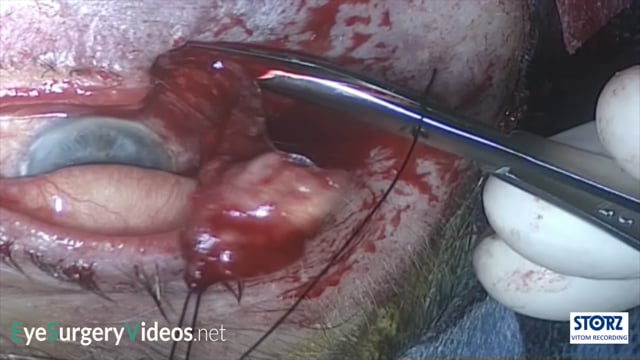
Around 50% of the upper lid has been excised. However, when the lid is everted and the tarsus assessed, there is around 4-5mm of residual tarsus superior to the defect. This can be advanced in a similar fashion to a Hughes flap to the lower lid, but of course just into the upper lid defect.
The merged septal-retractor fibres are dissected off the tarsal plate
The edges of the defect are continued as vertical incisions into the residual superior tarsal plate.
The flap is further released, until it can be advanced into the defect without any tension. As with a lower lid tarsoconjunctival flap, this dissection can be between Mullers and levator or between Mullers and conjunctiva which may be preferable as the attachment to conjunctiva alone probably increases its mobility and reduces tension that may cause lid retraction.
The flap is sutured in situ. It is sutured a couple of millimetres advanced of the neighbouring host tarsus as it tends to retract a little.
The advancement flap should have a little horizontal tension to keep the upper lid architecture and contour and In this case it is a little too wide so is trimmed.
The other side is sutured to the host tarsus.
An anterior lamella advancement flap is also created, utilising pre-existing dermatochalasis. The skin advancement flap is sutured 2-3mm recessed of the lid margin as it will advance and the tarsal flap will retract.
The reported complications and adverse outcomes of the sliding upper lid tarsoconjunctival flap are upper lid retraction, upper lid entropion and lagophthalmos.
This technique can also be used to reconstruct eyelid colobomas
References
- Hashish A, Awara AM. One-stage reconstruction technique for large congenital eyelid coloboma. Orbit 2011;30(4):177-9. doi: 10.3109/01676830.2011.582979
- deSousa JL, Malhotra R, Davis G. Sliding tarsal flap for reconstruction of large, shallow lower eyelid tarsal defects. Ophthal Plast Reconstr Surg 2007;23(1):46-8. doi: 10.1097/IOP.0b013e31802dd415
- Malik A, Shah-Desai S. Sliding tarsal advancement flap for upper eyelid reconstruction. Orbit 2014;33(2):124-6. doi: 10.3109/01676830.2013.814681
- Morley AM, deSousa JL, Selva D, et al. Techniques of upper eyelid reconstruction. Surv Ophthalmol 2010;55(3):256-71. doi: 10.1016/j.survophthal.2009.10.004